
Good Corporate Governance

Driving Integrity and Accountability for Sustainable Growth

Board of Commissioners Guidelines
The Board of Commissioners (BoC) plays an oversight role to ensure that the company operates responsibly, ethically, and in alignment with stakeholder interests. These guidelines define the duties, responsibilities, and code of conduct for Commissioners, including how they supervise the performance of the Board of Directors and provide strategic direction without interfering in day-to-day operations.
Board of Directors Guidelines
The Board of Directors (BoD) is responsible for the company’s operational execution and strategic implementation. These guidelines outline the roles, authorities, and governance principles that Directors must uphold in managing business activities, ensuring compliance, and achieving sustainable performance in line with the company’s vision and mission.
Audit Committee Charter
The Audit Committee Charter outlines the purpose, structure, authorities, and responsibilities of the Audit Committee in supporting the Board of Commissioners. It serves as a reference for the committee’s role in monitoring the integrity of financial reporting, internal control systems, risk management practices, and compliance with prevailing laws and regulations. The charter ensures that the Audit Committee operates independently, objectively, and in line with the principles of Good Corporate Governance.

Corporate Secretary

Sondy Ardy

The Company has appointed Sondy Ardy as Corporate Secretary, by virtue of Decree of the Board of Directors No. 1.038/IWI-JKT/SK-PD/III/2022 dated 21 March 2022.
Pursuant to the Financial Services Authority Regulation No. 35/POJK.04/2014 on Corporate Secretary of Issuers or Public Companies, the Company has appointed a Corporate Secretary responsible for maintaining good relationships with Shareholders, regulators, and all stakeholders. The Corporate Secretary is also responsible for assisting the President Director in ensuring consistent implementation of GCG.
Corporate Secretary Work Guidelines
The Corporate Secretary performs duties and responsibilities in accordance with the Company’s Articles of Association and Financial Services Authority Regulation No. 35/POJK.04/2014 on Corporate Secretary of Issuers or Public Companies.
Duties and Responsibilities of the Corporate Secretary
  1. Follow developments of the capital market, especially laws and regulations applicable to the capital market;
  2. Assist the Board of Directors and Board of Commissioners in implementing corporate governance which include information disclosure to the public;
  3. As a liaison /contact person between the Company and the Financial Services Authority and Indonesia Stock Exchange;
  4. Prepare and coordinate holding of the GMS and public exposure;
  5. Manage company administration in relation to obligations to the government and private sectors; and
  6. Provide information regarding matters of the Company, as stated in the Company Profile, to people who require it, in particular, prospective investors and Shareholders.

Internal Audit​

The Internal Audit Unit plays a vital role in supporting the Company’s management by overseeing the implementation of good governance, effective risk management, and internal controls. The audit functions are carried out independently, professionally, and objectively to enhance corporate value and operational performance.

In addition to performing internal reviews, the unit ensures compliance with applicable regulations across financial management, data processing, asset control, and other critical functions. The Internal Audit Unit operates directly under the President Director and follows the OJK Regulation No. 56/POJK.04/2015 as its working guideline.

Internal Control System

The Internal Control System is a critical component of the Company’s management framework, designed to ensure that all business activities are aligned with prevailing laws and regulations. This system helps safeguard company assets, supports accurate financial reporting, and enhances overall compliance.

Implemented comprehensively across all organizational levels—from business units to the Board of Directors and Commissioners—the control system is supported by internal and external audits under the Company’s Risk Management framework. Regular evaluations are conducted to ensure effectiveness and adaptability in response to operational complexity and business expansion. These measures help minimize risks of losses, irregularities, and violations across financial, operational, and regulatory dimensions.

Risk Management

In response to the dynamic and competitive nature of the chemical industry, Intanwijaya implements a proactive and structured risk management system to minimize business and sustainability risks. Responsibility for managing risk is embedded across all levels of management and functions.

A dedicated risk management framework forms an integral part of Intanwijaya’s internal control system. This framework enables every employee to identify risks relevant to their duties and promotes a risk-aware culture throughout the organization. Risk profiles are regularly reviewed and updated, considering both internal developments and external dynamics. Risk management at Intanwijaya is carried out by the Customer Credit Risk Management (CCRM) unit through a systematic, structured, and integrated approach.

Transparency Information

Intanwijaya upholds the principles of transparency and accountability in line with POJK No. 31/POJK.04/2015 concerning Disclosure of Material Information or Facts by Public Companies. As a publicly listed company, Intanwijaya is committed to providing clear, accurate, and timely information about its performance, products, services, and other relevant matters to stakeholders.

This transparency is maintained through the official website, which is regularly updated with financial reports, press releases, CSR initiatives, annual reports, product information, and corporate actions—available in both Indonesian and English. Intanwijaya also disseminates information via national print media, periodic reports to regulators, and public expos, all while respecting confidentiality requirements under applicable laws.

Code of Conduct

Intanwijaya promotes an ethical and disciplined work culture by establishing clear company regulations and expected standards of behavior. While the formal Code of Conduct is in development, these regulations serve as the foundation for day-to-day conduct across all levels of the organization.

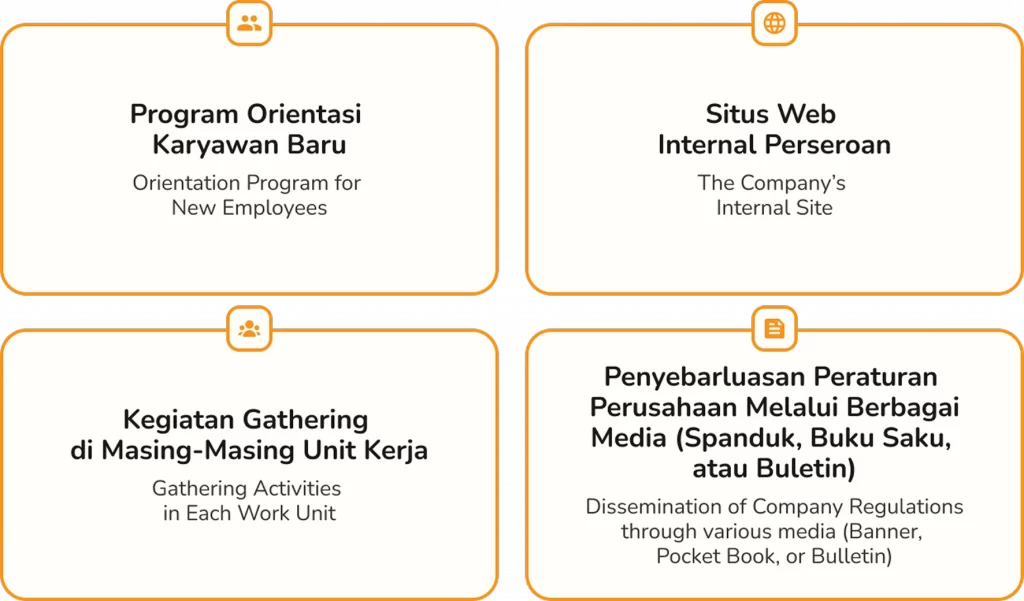
To ensure consistent understanding and application, Intanwijaya actively disseminates these regulations through employee orientation programs, internal platforms, work unit gatherings, and printed materials such as banners, pocketbooks, and bulletins.
Anti-Corruption Policy

Intanwijaya is firmly committed to conducting its business with integrity, ethical standards, and compliance with all applicable laws and regulations. To reinforce this commitment and support government efforts in eradicating bribery and corruption, Intanwijaya has established an Anti-Bribery and Anti-Corruption Policy (Policy No. 1.117/IWI-JKT/PD/IX/2021), effective since September 30, 2021.

The policy applies to all employees, business partners, and public institutions related to the company, with key objectives including:

  • Preventing both material and immaterial losses that may threaten business continuity;
  • Raising awareness of Good Corporate Governance (GCG) in interactions with external parties;
  • Providing operational clarity for stakeholders in executing their duties;
  • Strengthening compliance with laws and ethical standards while supporting national anti-corruption programs.

Intanwijaya also encourages active participation from employees and external parties through its Whistleblowing System, ensuring a transparent channel to report any alleged corrupt practices. The company acknowledges every contribution toward upholding a corruption-free work environment.

Whistleblowing System

To strengthen its governance and integrity culture, Intanwijaya has established a Whistleblowing System (WBS) as an oversight mechanism that involves all organizational levels. This system allows both internal and external parties to report any indication of fraud, procedural violations, unlawful acts, unethical conduct, or breaches of company policies.

The Violation Reporting Management Team (TPPP) handles incoming reports and evaluates them through special meetings. If the report meets the formal requirements, it is escalated for follow-up. Reports that cannot be pursued are formally closed with approval from the Board of Commissioners or Board of Directors. When necessary, TPPP may request support from Internal Audit, external consultants, or third-party auditors with prior approval.

Whistleblower Protection

Intanwijaya guarantees full confidentiality and protection for whistleblowers, including:

  • Anonymity of identity and report content
  • Protection against threats, intimidation, or retaliation
  • Safeguards against demotion, dismissal, or discrimination


In 2024, there were no reported violations submitted to the Company or its subsidiaries.

Materials

Deed of Establishment
Jul 7, 2015
Deed of Justice
Jul 7, 2015